

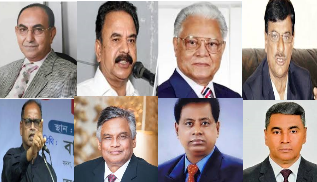
Discussions are underway within the Bangladesh Nationalist Party (BNP) regarding significant organizational and governmental changes aimed at enhancing coordination between the government and the party while making the organizational structure more dynamic and effective According to various party sources, a partial cabinet reshuffle may take place in the near future. At the same time, the long-discussed principle of “One Leader, One Position” is being seriously considered for implementation.
Sources indicate that if a cabinet reshuffle occurs, several senior BNP leaders could be entrusted with key ministerial responsibilities. Among the names reportedly under consideration are Mirza Abbas, Goyeshwar Chandra Roy, Altaf Hossain Chowdhury, Zainul Abdin Farroque, Shamsuzzaman Dudu, Aman Ullah Aman, and ABM Mosharraf Hossain. The name of Dhaka-18 Member of Parliament SM Jahangir Hossain has also emerged as a potential representative of the younger generation of leadership. However, a responsible party source stated that no final decision has yet been made regarding the timing of the reshuffle or the inclusion of new cabinet members.
Political observers note that many of BNP’s senior leaders currently hold important positions both in government and within the party organization. This dual responsibility has raised concerns about maintaining an effective balance between administrative duties and organizational activities. Party policymakers believe that a clearer division of responsibilities is necessary to strengthen both governance and party operations.
In this context, discussions are taking place about removing ministers and Members of Parliament from key organizational positions at the central, district, metropolitan, upazila, and thana levels and creating opportunities for new leaders to emerge. Party leaders believe that such a move would encourage leadership development and inject new momentum into organizational activities.
The political philosophy of BNP founder and former President Ziaur Rahman emphasized decentralization of responsibilities and the cultivation of new leadership. According to veteran party leaders, during his tenure a clear distinction was maintained between government responsibilities and party duties. Ministers and MPs generally did not hold district or local organizational positions, allowing them to focus on administrative responsibilities while creating space for new leadership within the party.
In line with this philosophy, BNP incorporated the “One Leader, One Position” principle into its constitution during the party’s Sixth National Council in 2016. However, due to political realities and organizational necessities, many leaders have continued to hold multiple positions. The party is now reportedly revisiting the policy in an effort to improve efficiency in both government administration and organizational management.
Party sources say that several leaders of Dhaka Metropolitan BNP, Jubo Dal, and Swechchhasebak Dal currently serve as MPs or members of the cabinet. These include State Minister for Sports and Convener of Dhaka North BNP Aminul Haque; Dhaka-18 MP and Joint Convener of Dhaka North BNP SM Jahangir Hossain; Feni-1 MP and Convener of South BNP Rafiqul Alam Majnu; Jubo Dal General Secretary and Bhola-4 MP Nurul Islam Nayan; Swechchhasebak Dal President and Gopalganj-3 MP SM Jilani; and State Minister Rajib Ahsan, MP from Barishal-4.
Sources further claim that restructuring efforts have already begun within several organizational units with the objective of establishing new leadership. The party aims to expand its activities further at the grassroots level by bringing forward a new generation of leaders.
A similar situation exists at the district and metropolitan levels, where several MPs simultaneously hold important party positions. Among them are Shahid Uddin Chowdhury Annie, Convener of Lakshmipur District BNP; Relief and Disaster Management Minister Asadul Habib Dulu, President of Lalmonirhat District BNP; State Minister for Water Resources Farhad Hossain Azad, Member Secretary of Panchagarh District BNP; Shahjahan Chowdhury, President of Cox’s Bazar District BNP; Monowar Hossain Khan, Member Secretary of Magura District BNP; Ershad Ullah, Convener of Chattogram Metropolitan BNP; Jahandar Ali Jahan, Member Secretary of Madaripur District BNP; and Biswas Jahangir Alam, President of Narail District BNP.
Additional MPs serving in district-level party roles include Saching Prue, Convener of Bandarban District BNP; Emran Ahmed Chowdhury, General Secretary of Sylhet District BNP; BNP Joint Secretary General Khairul Kabir Khokon, President of Narsingdi District BNP; Monjur Elahi, General Secretary of Narsingdi District BNP; Abdul Gafur Sarkar, President of Nilphamari District BNP; Faridul Kabir Talukdar Shamim, President of Jamalpur District BNP; Shah Md. Waresh Ali Mamun, General Secretary of the district unit; Sheikh Farid Ahmed Manik, President of Chandpur District BNP; and Khaled Hossain Mahbub Shyamal, President of Brahmanbaria District BNP.
Party policymakers argue that when a leader simultaneously handles major responsibilities in both government and party structures, limitations in time and attention often emerge, making it difficult to achieve optimal results in either sphere. As a result, efforts are being made to distribute responsibilities more effectively.
Speaking on the issue, BNP Vice Chairman Shamsuzzaman Dudu stated that during Ziaur Rahman’s era, a clear distinction was maintained between the party and the government. Ministers and MPs often relinquished district-level leadership positions to create opportunities for others, which contributed to the development of new leadership and strengthened the party’s organizational base.
He further noted that the current government is still relatively new and that greater coordination between the government and the party is expected to develop over time. Although many leaders have held multiple responsibilities due to various circumstances, the implementation of the “One Leader, One Position” policy may become more visible in the future.
Political analysts believe that if BNP successfully implements this policy, it could pave the way for the emergence of new leadership and bring renewed momentum to the party’s organizational activities. At the same time, leaders serving in government would be able to devote greater attention to administrative responsibilities, thereby improving both governance and organizational efficiency.
However, observers caution that implementing such a policy will require careful consideration of party unity, organizational realities, and the broader political environment. Replacing long-serving leaders with new faces is likely to be a gradual and sensitive process.
Overall, discussions surrounding a possible cabinet reshuffle and organizational restructuring within BNP have generated significant interest in political circles. While no official announcement has yet been made, party sources suggest that important decisions may soon be taken to ensure a more balanced distribution of responsibilities between the government and the party. If implemented, these changes could mark the beginning of a new chapter in BNP’s organizational development and governance strategy.